Cigar humidor guide: humidity, seasoning and care
Cigario editorial · updated 1 October 2026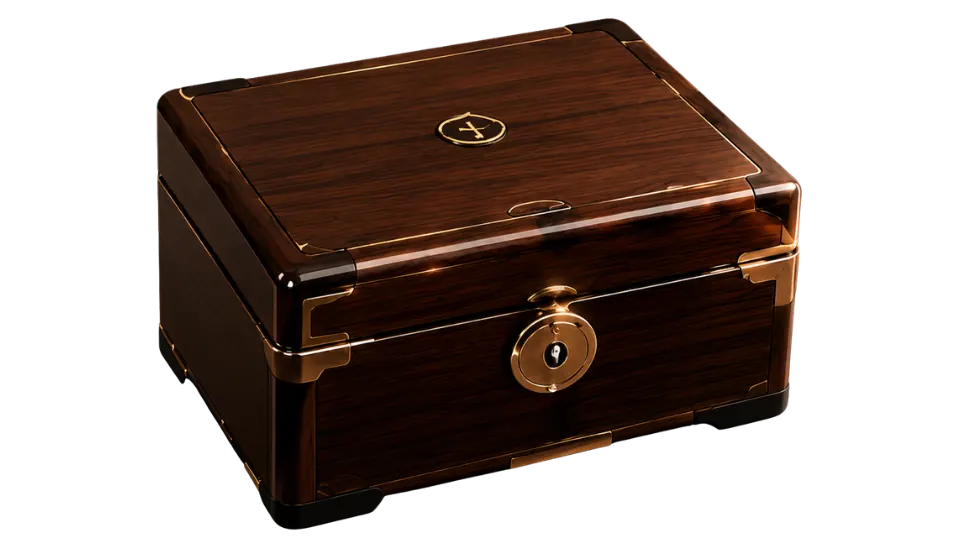
A cigar is a natural product that keeps breathing after it is rolled. Too dry and it cracks and burns hot; too moist and it draws badly and can grow mold. A humidor simply keeps cigars in a stable climate, and it is much easier to run than it looks.
- Aim for 65–70% relative humidity and 18–21 °C (64–70 °F).
- Stability beats precision: avoid big swings.
- Season a new wooden humidor before you fill it.
- Two-way humidity packs are the easiest way to start.
- Calibrate your hygrometer and check it weekly.
Why humidity matters
Steady beats perfect: a stable 67% is better than a jumpy 70%.
Cigars are rolled at a humidity of around 70% in the tropics. In a normal heated room, humidity can drop to 30–40%, and an unprotected cigar dries out within days to a few weeks. Too much moisture is just as bad: the tobacco swells, the draw tightens and mold becomes a real risk.
| Condition | What happens |
|---|---|
| Below 60% | Wrapper becomes brittle and can crack; the cigar burns fast, hot and harsh. |
| 62–70% | The comfort zone. Many smokers prefer 65% for full-bodied cigars and up to 69% for milder ones. |
| Above 72% | Tight draw, uneven burn, frequent relights and a growing risk of mold. |
| Above 24 °C (75 °F) | Tobacco beetle eggs can hatch. Keep the humidor away from heat and sun. |
Choose the right humidor
Season a new wooden humidor
New cedar is bone dry. If you put cigars straight in, the wood pulls moisture out of them. Seasoning means letting the wood absorb moisture first, slowly, until the reading stays steady.
The cedar first absorbs moisture. Wait until the reading holds steady for 2–3 days.

How to keep the humidity
Calibrate your hygrometer
Cheap analogue hygrometers can be off by 5–10%. Digital ones are better, but check them too. The classic salt test costs almost nothing:
Problems and fixes
| Problem | Likely cause | Fix |
|---|---|---|
| Humidity keeps dropping | Leaky seal, dry wood, empty humidifier | Check the seal with a paper slip in the lid; refill or add a pack. |
| Humidity too high | Too much water, warm room | Leave the lid open briefly, remove a pack, add a 62% pack. |
| Fuzzy blue-green spots | Mold | Remove affected cigars, wipe the interior, lower humidity, check temperature. |
| Fine white crystals that brush off | Plume (bloom) | Harmless and rare; it simply brushes away. |
| Tiny pin holes in cigars | Tobacco beetle | Freeze cigars in sealed bags, then thaw slowly in the fridge; check temperature. |
A simple routine
- Weekly: check humidity and temperature, refill or replace packs.
- Monthly: rotate cigars from top to bottom and look for spots or holes.
- Every six months: recalibrate the hygrometer with the salt test.
- Always: keep the humidor away from windows, radiators and air conditioning.
Frequently asked questions
What is the best humidity for cigars?
Most smokers keep 65–70%. Lower (around 65%) suits full-bodied cigars and a crisp burn; higher (up to 69–70%) suits milder cigars.
Should I remove the cellophane?
Either works. Cellophane slows down exchange with the humidor and protects wrappers; without it, cigars age a little faster and share aromas more.
Can I store cigars in the fridge?
Not long term. A fridge is too dry and smells of food. It is useful only for freezing against beetles, in sealed bags.
Can different cigars share one humidor?
Yes. Strongly aromatic or infused cigars are best kept in their own box or a separate container.
How long can cigars stay in a humidor?
Years, if the conditions are stable. Many smokers rest new cigars for a few weeks before smoking them.
Keep reading
 Basics · 4 min readHow to identify a cigar: read the band, size and wrapperWhat cigar is this? A practical way to identify any cigar from its band, size and wrapper, what to do when the…
 Industry · 5 min readWhere premium cigars come from: U.S. import data by country (2026)Nicaragua, the Dominican Republic and Honduras make almost every premium cigar sold in the United States. The…
 Buying · 7 min readHow to spot fake Cuban cigars: the complete checklistCounterfeit Cohibas, glass-top boxes, bogus Behikes and loose seals. How to check the box, the Habanos warranty…